
What Happens To Mezcal When Rested In Glass
In a room at José Alberto's palenque, the área de descansar, dark and cool behind painted red stucco walls, the destilado rests. Some of it rests in food-grade plastic totes, stacked on cool concrete and lined against stone. Some of it rests in glass garrafónes, rotund glass jugs, some of them decades old. This room is one of my favorite places to spend time when visiting the palenque. It has the quality of a place where you need to be invited in, where something beautiful is happening - quietly, slowly, without drawing attention. It is a resting room, but the mezcal is still working.
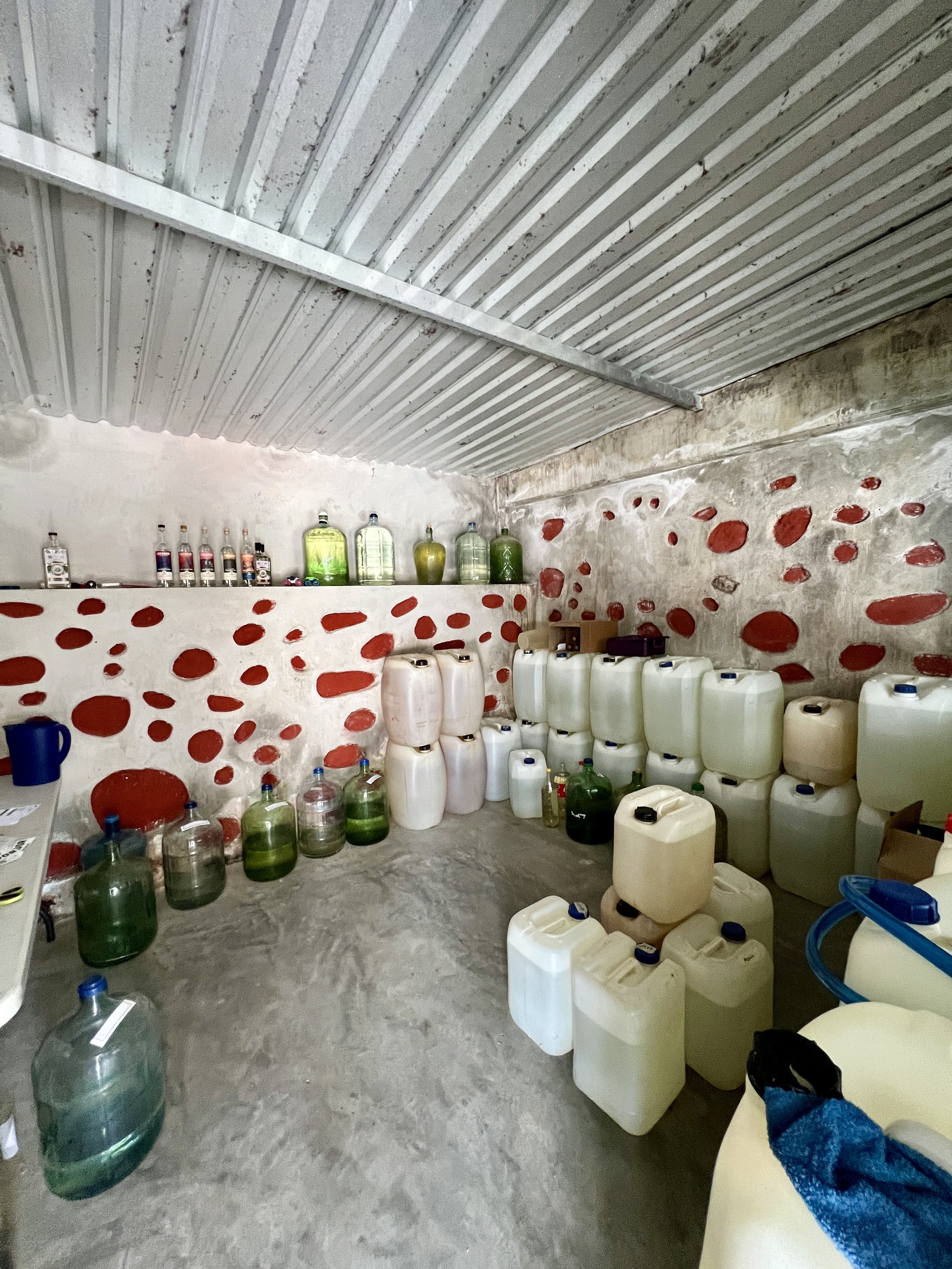
Área de descansar - the resting room at José Alberto’s palenque
A History of Resting in Glass
Resting mezcal in glass has a history shaped in part by necessity and in part by something closer to folklore.
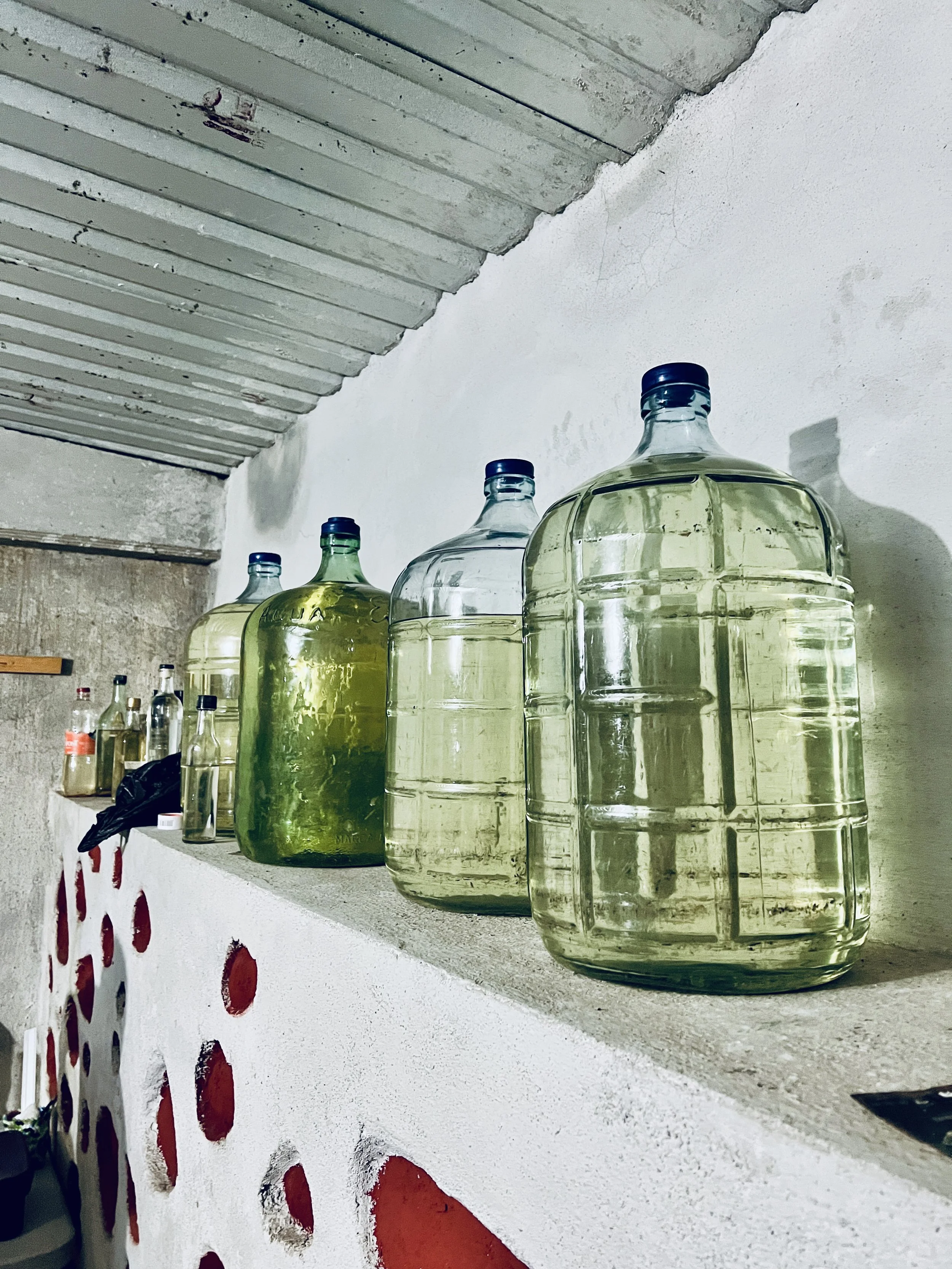
For much of the 19th and early 20th century, mezcal production in parts of Mexico operated under repressive taxation and periods of prohibition, with authorities destroying stills and seizing stock. Producers hid their mezcal wherever they could, sealed in glass garrafónes beneath dirt floors or buried in the hills around their villages. What began as concealment became, over time, a sort of practice. The spirit that had been hidden for a year, for two years, tasted different than what had come fresh off the still. The hiding had done something good to it. The madurado en vidrio (matured in glass) category that exists in mezcal regulation today, spirits formally rested in glass, is, in part, a direct descendant of that discovery/tradition.
The cultural significance of glass resting extends into community life as well. In some communities across Mexico, the practice of setting aside mezcal in a sealed glass vessel at the birth of a child, to be opened years later at a quinceañera, or a wedding, or another milestone, has been observed across generations. This is a kind of practice that emerges when you have a spirit that improves with time, a vessel that preserves it faithfully, and a culture that marks the passages of life with celebrations, and mezcal.
There is something inescapable when it comes to mezcal and time - the years it takes the agave to reach maturity, the time to mill, ferment, and then distill. And then finally that time in glass, resting, waiting, working.
Reposado, Añejo, Madurado, Descansado
Nomenclature for resting certified agave spirits has been defined by the CRT (Consejo Regulador del Tequila) and the CRM (Consejo Regulador del Mezcal), the governing bodies in Mexico for tequila and mezcal respectively. The CRT uses the term reposado to describe tequila that has been aged 2 months to a year in oak barrels, and anejo to describe tequila that is aged 1 or more years. The CRM uses the term madurado en vidrio - matured in glass - to describe the formal resting of spirits in certified mezcal.
But like many things in mezcal, what has been regulated by governing bodies and what is of the people at times diverge. Creador is agave spirit, not certified mezcal, and José Alberto and I decided to use the colloquial term, the term used in the community - descansado - which translates to rested, or taking a break. We released a batch a few years ago, Tobalá Descansado, which translates to “rested tobalá”, which sat in glass at the palenque for 4 years. Future batches of Creador, glass rested at the palenque, will have a similar designation. For the batches rested in Texas, when bottled, they will receive a sticker. More on that below.
The Garrafón
A garrafón is a large glass jug, typically 5 or 6 gallons (about 18 liters to 22 liters), used in Mexico to store water, mezcal, and whatever else. The garrafónes you encounter across Oaxaca descend from a glass-making tradition that expanded significantly in Mexico through the mid-20th century as the glass industry, originating in Puebla, flourished. By the mid-1990s, plastic largely displaced glass for everyday use, which is why the old garrafónes are now harder to find and considerably more expensive. A broken garrafón at the palenque is a meaningful loss, and so food-grade plastic containers are not only more affordable, but practical as well.
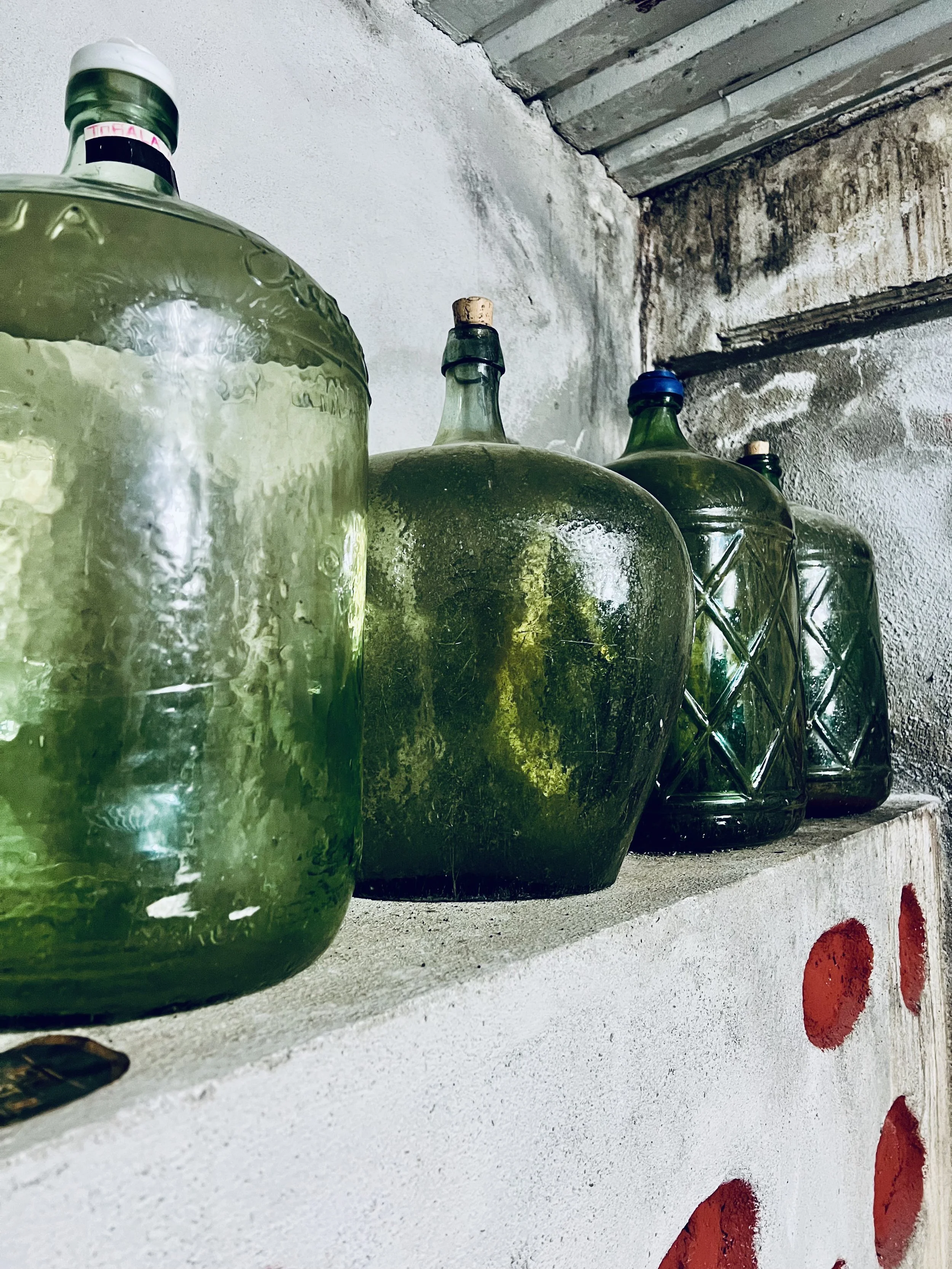
Vintage garrafónes at the palenque
What Happens in the Glass
I am not a scientist, nor do I claim to be one or play one on TV. In this next bit I’ll attempt to explain what is happening in the glass. There will not be a test.
Unlike resting in wood, like with tequila, where the spirit and the barrel are in active chemical conversion, the spirit drawing color, tannins, vanillins, and other compounds from the oak, resting in glass is fundamentally different. Glass is inert. It gives nothing and takes nothing. What it offers is time and a contained environment in which the spirit evolves through its own internal chemistry.
The primary process at work is slow oxidation. Glass vessels, especially when sealed with natural cork or stoppered with a more traditional corncob or carved piece of quiote, permit a very gradual interaction between the mezcal and oxygen. It is measured and unhurried, and takes years to soften what is sharp and round what is angular.
At the molecular level, a freshly distilled agave spirit contains a volatile mix of compounds. Alcohols, esters, aldehydes, and fatty acids are some of those compounds, freshly integrated and still finding equilibrium with one another. Ethanol and water molecules, which don't naturally integrate at the molecular scale, undergo a slow association over time, a clustering, which is thought to contribute to the perceived smoothness of a rested spirit. The harsher, more volatile aldehydes, the compounds that give a fresh distillate some of its edge, oxidize and either evaporate or convert into less aggressive forms. Esters, which contribute fruity and floral character, continue to form slowly as acids and alcohols interact. The mezcal is working, even as it rests.
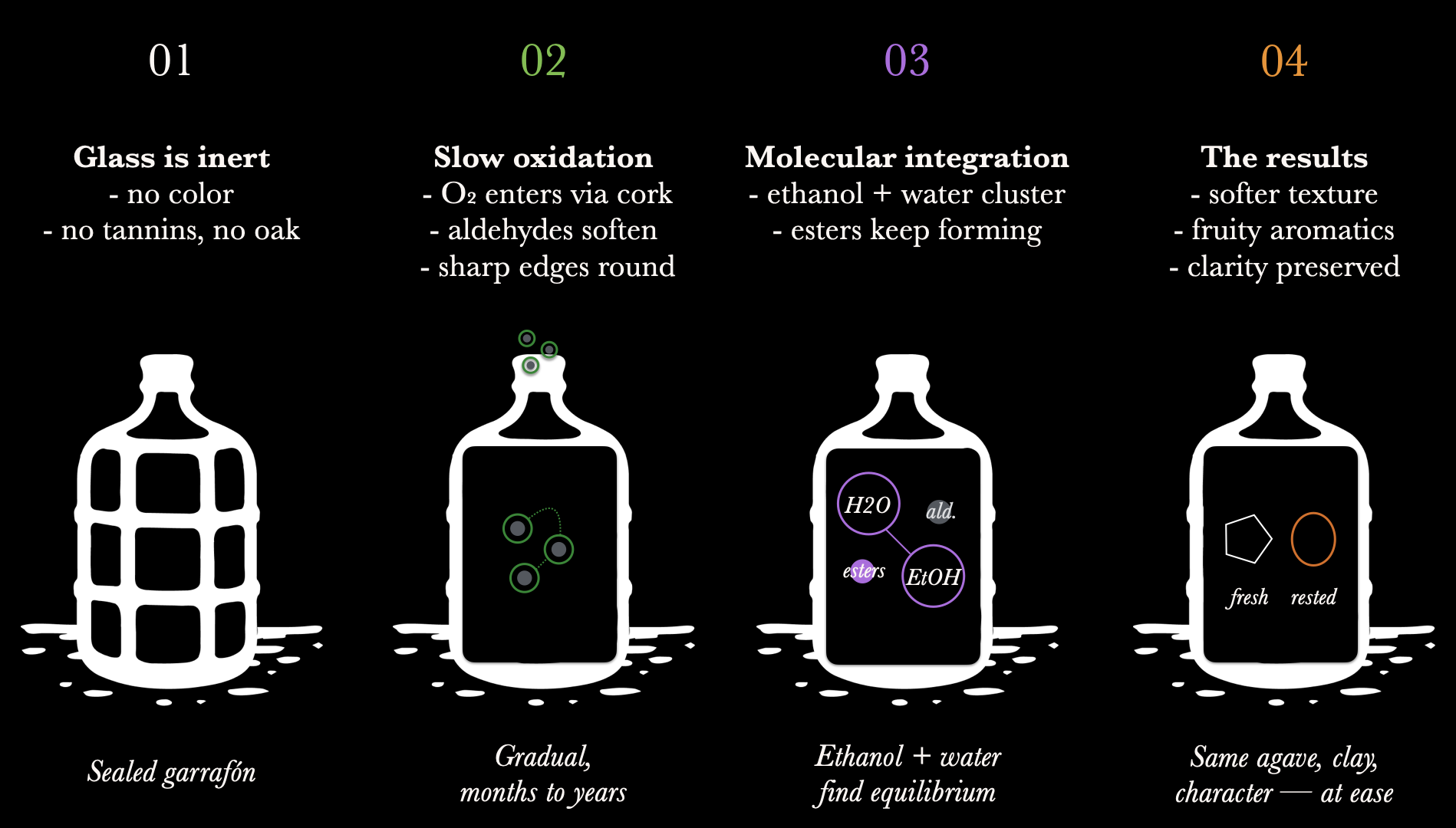
These four steps, plus time
The color of the spirit doesn’t change. A spirit rested in glass for years emerges as clear as it went in. This is the crucial visual distinction from barrel aging as wood adds color along with flavor. Glass adds neither. What glass-rested spirits offer is not the vanilla and caramel of oak maturation, but a more fully integrated version of the same agave. The spirits can be softer in texture, with the fruit, earth, and clay notes present from distillation settled and cohesive.
Glass vs. Plastic
This brings us to the question of glass versus food-grade plastic, because both are used at José Alberto's palenque, and food-grade plastic is certainly used to store mezcal at every other palenque I’ve visited, and both are legitimate vessels for storing agave spirits.
Food-grade plastic, the high-density polyethylene totes that you see in palenques across Mexico, is inert, like glass, in the sense that it doesn't impart flavor compounds to the spirit. The CRM recognize it as an acceptable storage vessel, and it is widely used precisely because it is affordable, durable, comes in very large sizes, and doesn't break.
The difference lies in permeability. Glass is essentially impermeable, and the only oxygen exchange that occurs is through whatever seal is on the vessel, controlled by the stopper or cork. High-density food-grade plastic is microscopically permeable so some oxidation does occur over very long resting periods, though at an incredibly slow rate. In my own observation, mezcal stored in food-grade plastic shows no discernible change after being stored for a year and even more.
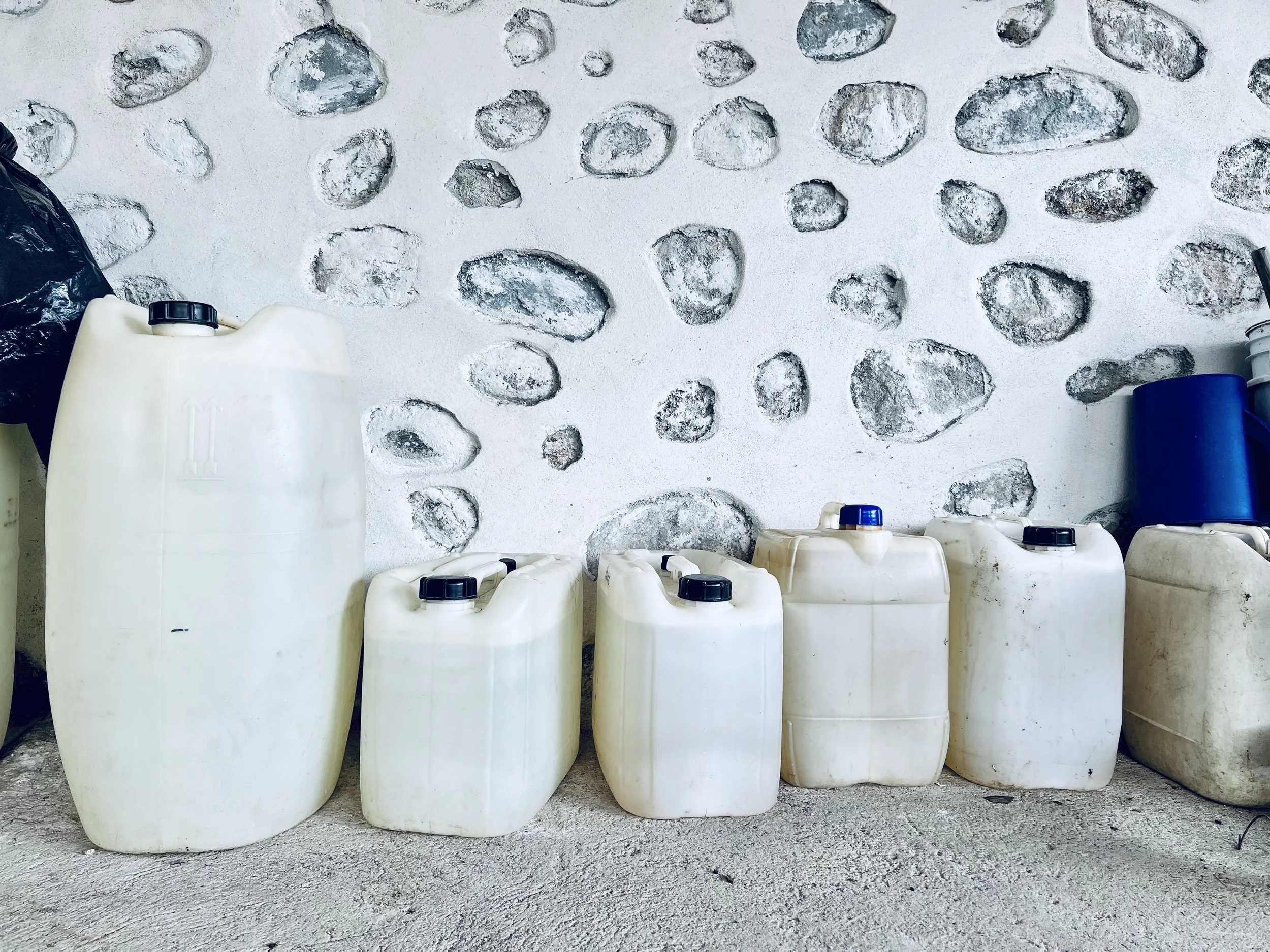
Mezcal stored in food grade plastic totes at the palenque
Resting batches in Bastrop, Texas
José Alberto’s distillates are shipped in bulk to Genius Distillery in Bastrop, TX. Here, the batches are bottled by yours truly, sold to distributors (and at the Bar Singular tasting room), and make their way to you. After talking to José Alberto, we agreed it would be a good idea to rest some of those batches further, after they’ve made the 1,112 mile trip from San Bernardo Mixtepec. So I've been pulling small amounts from those batches and resting in glass here in Bastrop (Mixtepec!).
Several expressions of Creador are currently resting in garrafónes at the distillery, using the same type of garrafónes found in Mexico. They sit in a cool, dark area of the facility, sealed and largely undisturbed, the mezcal inside slowly doing what time wants it to do. The garrafónes are sealed with rubber stoppers that are opened about every four months to expose to oxygen. The garrafónes sealed with corks, which are permeable, are left closed. About once a year I will taste, bottle a small sample, and return to San Bernardo Mixtepec to share with José Alberto.
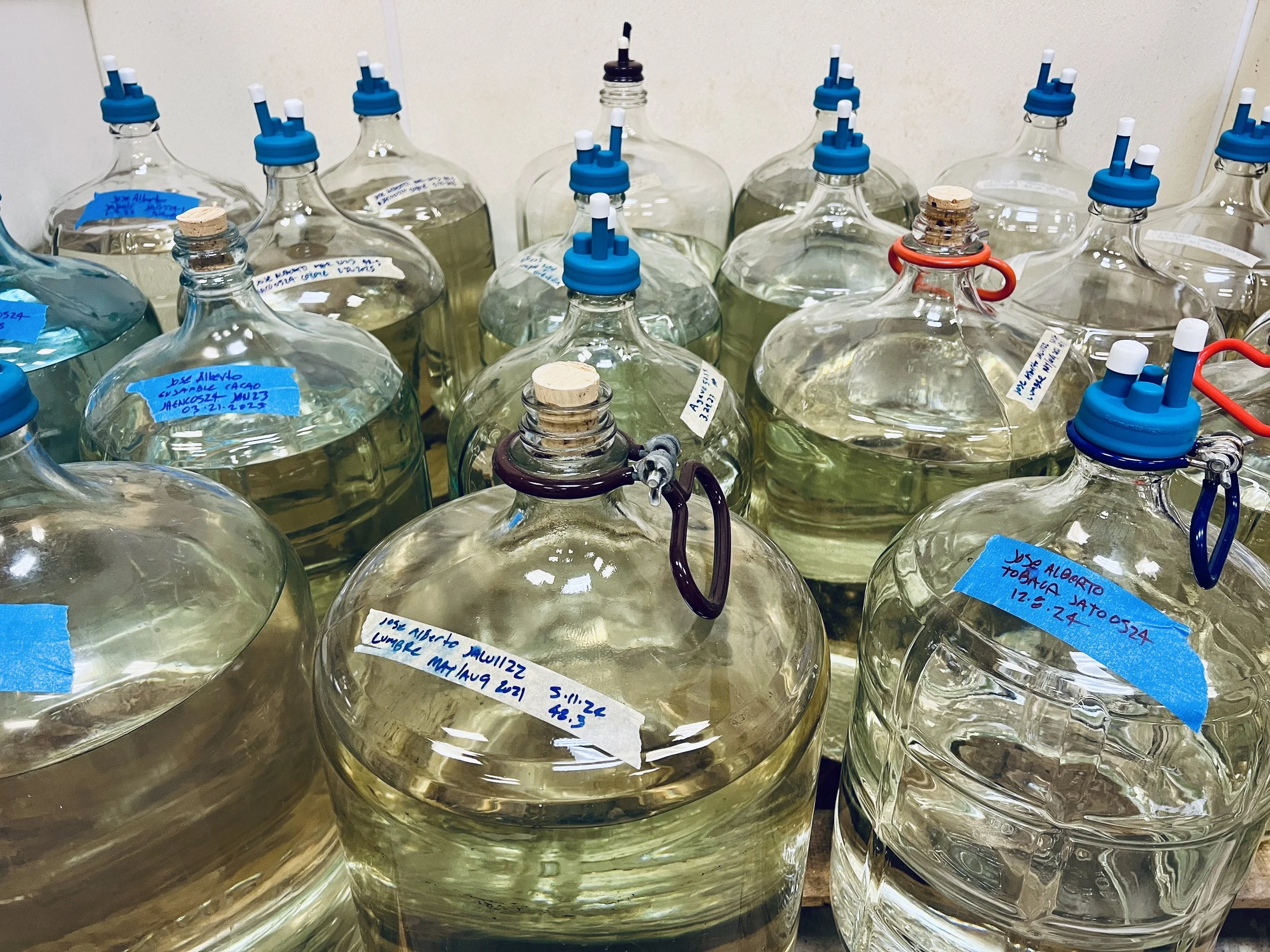
Resting José Alberto’s mezcal in glass in Bastrop (Mixtepec!)
José Alberto rests his spirits for at least six months, and usually much longer before they leave the palenque. What arrives in Bastrop has already been through a first period of integration. What happens next, in the garrafónes, in Bastrop (Mixtepec!), over additional months and years, is a continuation of his tradition, and also something new and exciting that hasn’t been done before. We started this partly because we can, and to my knowledge, there is no-one else doing this outside of Mexico (punk rock!).
I’m starting to share some of the expressions. For over two years they have been resting in Texas in glass, and in the food-grade plastic they were imported in before that. The production dates make some of the batches more than five years old, and have been stored, resting, in bulk containers for all that time.
The mezcal we've pulled from the garrafónes for comparison tasting at Bar Singular (the tasting room at the distillery in Bastrop) does have a different quality. It’s still José Alberto’s destilado. It’s just been taking a break before it gets back to work. Come on out and try for yourself sometime.
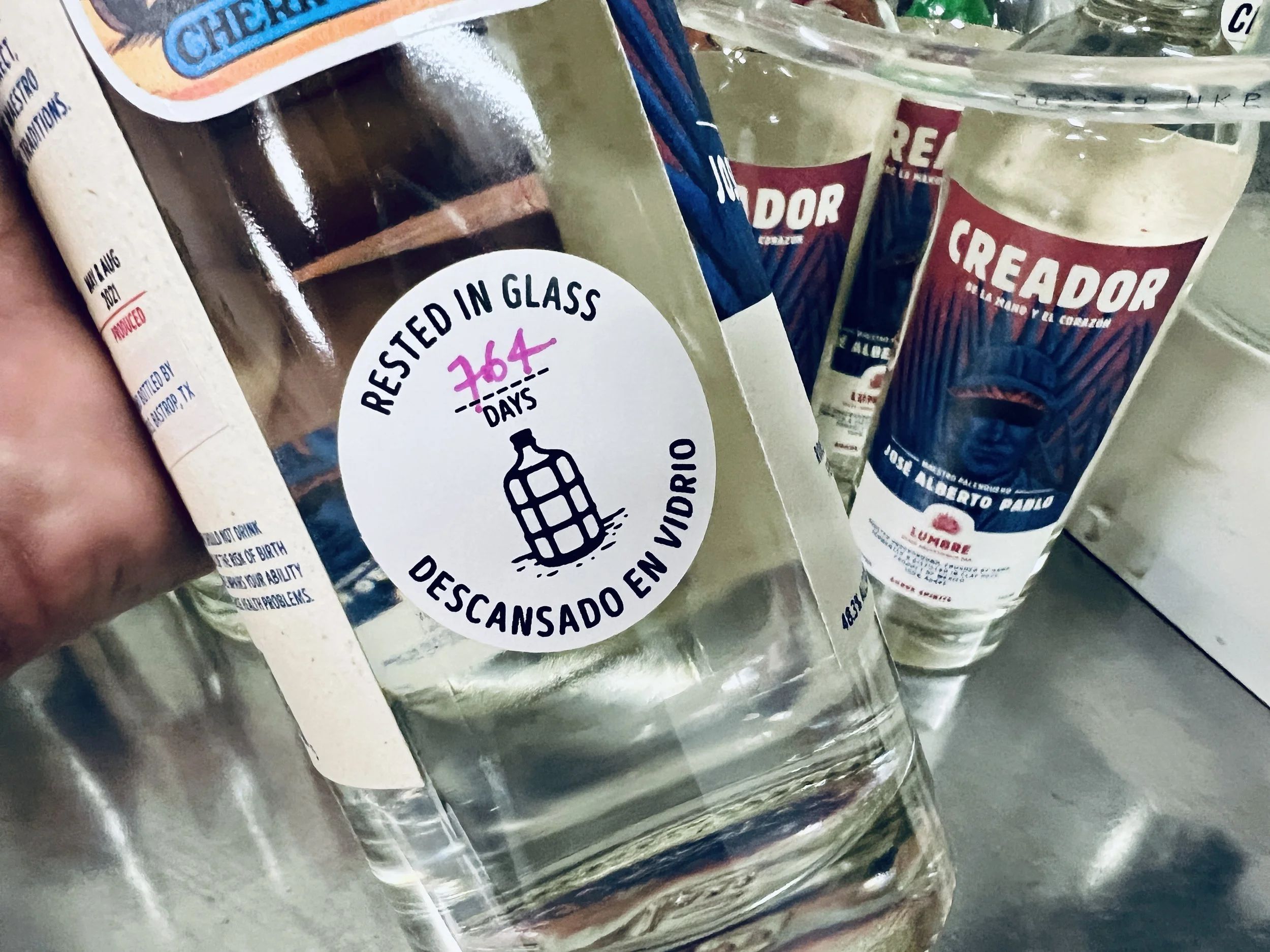
Look for this sticker
Finally, some of the small glass-rested batches are now available in the market. The Austin Shaker are the first to pick some batches, debuting at their 12 Days of Agave event July 6. Since the garrafónes hold 18-22 liters, the batches are extremely small - 24 - 36 bottles. Look for the sticker above on the bottle as it indicates how many days the spirit has been resting in glass in Texas. And if you are interested in your own small glass-rested batch, send an email below.
Salud!
Marcus
Questions about glass resting, or anything related to Creador? Send an email.