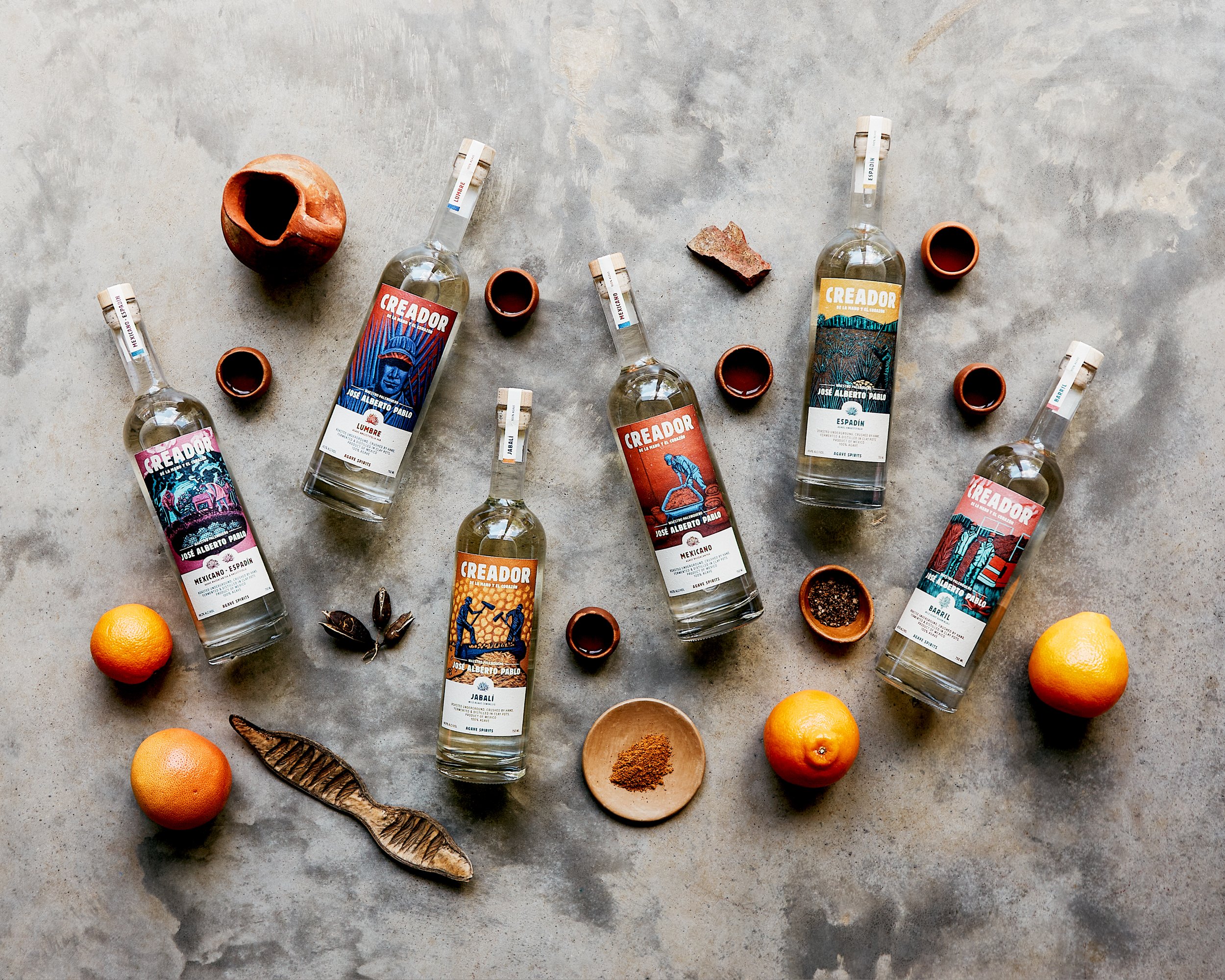
Thank you for your supporting Creador.

Each expression started by cooking agave piñas in an underground river rock-lined stone oven (el horno), mashing the cooked piñas by hand with mallets (mazos) in a hollowed tree trunk (canoa), then fermenting in half-buried 90-liter clay pots, and distilling twice in 60-liter clay pots.

ESPADÍN

Cultivated in San Bernardo Mixtepec in the Zimatlán region of Oaxaca, agave angustifolia, the agave that is used to create espadín (eh-spa-DEEN), was introduced to this region in the 1990s. At an elevation of 1651 meters (approximately 5416 ft), high in the hills above the pueblo, espadín here takes 8-10 years to reach maturity.

Fermented and distilled in clay, José Alberto’s espadín is rich and full-bodied.

Species: Agave angustifolia

Batch number: JAES0422

Bottling size: 150 liters (200 bottles)

Produced: Mar 2020 (250 total liters)

Alcohol by volume (ABV): 49.4%

Tech sheet (PDF)

Tasting notes: Mezcal Reviews | Mezcalistas

Write a review

LUMBRE

Cultivated in San Bernardo Mixtepec in the Zimatlán region of Oaxaca, agave lumbre ( LOOM-bray) is endemic to the region and predates the introduction of espadín. At an elevation of approximately 1651 meters, high in the hills above the pueblo, agave lumbre takes 8-10 years to reach maturity. Similar in appearance to espadín, lumbre can be identified by a red coloration at the base of the agave, which is where lumbre draws its name - lumbre translates to fire.

Fermented and distilled in clay, lumbre is robust and full in flavor, and is the signature destilado by José Alberto.

Species: Agave angustifolia var.

Batch number: JALU0422

Bottling size: 150 liters (200 bottles)

Produced: Mar 2020 (200 total liters)

Alcohol by volume (ABV): 48.3%

Tech sheet (PDF)

Tasting notes: Mezcal Reviews | Mezcalistas

Write a review

MEXICANO

In José Alberto’s home pueblo of San Bernardo Mixtepec and surrounding areas agave rhodacantha, as well as several variations of rhodacantha, grows wild and is also cultivated. Low and broad, with thinner pencas than the angustifolias, mexicano (pronounced MEH-he-kah-no) takes 10-12 years to reach maturity at an elevation of approximately 1651 meters. Cultivated and harvested in nearby Zimatlán de Alvarez, this mexicano is peppery with a dry and refined finish.

Species: Agave rhodacantha

Batch number: JAME0422

Bottling size: 100 liters (133 bottles)

Produced: Jan 2021 (200 total liters)

Alcohol by volume (ABV): 49.2%

Tech sheet (PDF)

Tasting notes: Mezcal Reviews | Mezcalistas

Write a review

MEXICANO + ESPADÍN ENSAMBLE

For his ensambles, José Alberto pairs two agaves and uses a 50/50 mix to highlight the characteristics of each one. The agaves are harvested and then cooked together in el horno for 3-5 days. They are milled together by hand, and also fermented and then distilled together, making them a blend from the start of the process until the finish.

Species: Agave rhodacantha & angustifolia

Batch number: JAEN0422

Bottling size: 100 liters (133 bottles)

Produced: May 2020( 250 total liters)

Alcohol by volume (ABV): 48.2%

Tech sheet (PDF)

Tasting notes: Mezcal Reviews | Mezcalistas

Write a review

BARRIL

Harvested wild (silvestre) near Sola de Vega, Oaxaca, this is the first batch of barril ( bah-REEL) that José Alberto has produced. At a source elevation of approximately 1499 meters, barril grows tall like a tree and takes 12-14 years to reach maturity.

We think this first batch of barril is exceptional, enhancing the typical notes and qualities of this karwinskii with José Alberto’s tried and true methods of clay pot fermentation and distillation.

Species: Agave karwinskii

Batch number: JABA0422 (*first batch)

Bottling size: 100 liters (133 bottles)

Produced: Feb 2021 (220 total liters)

Alcohol by volume (ABV): 48.2%

Tech sheet (PDF)

Tasting notes: Mezcal Reviews | Mezcalistas

Write a review

JABALÍ

Harvested wild (silvestre) near Sola De Vega in the Sierra Sur region of Oaxaca, agave convallis which is used to make jabalí ( hah-bah-LEE) is challenging to work. When José Alberto learned of the difficulty to work jabalí, he wanted to take on the challenge, and this first batch produced is certainly worth it.

There are a few troubles working with jabalí. First, the piñas have a lower yield compared to higher yield agaves. Second, during fermentation and distillation, the bagasso produces a lot of foam, which needs to be monitored and removed because it contains unwanted saponins and can also damage the stills.

With the low yield and the foam combined the effort is not worth the return, and some producers will mix jabalí with another agave to create a full batch. What makes this batch special is not only that it is made from 100% agave convallis, but that it is also José Alberto’s first, and the results are outstanding.

Species: Agave convallis

Batch number: JAJA0422 (*first batch)

Bottling size: 100 liters (133 bottles)

Produced: April 2021 (190 total liters)

Alcohol by volume (ABV): 48.9%

Tech sheet (PDF)

Tasting notes: Mezcal Reviews | Mezcalistas

Write a review